If this were my last blog post, what would I say?
Never take anything at face-value. There's always a catch, especially in politics. "The catch" can often be found in how things are phrased and what words politicians choose to use over other words. It's these types of things that I've been trying to point out. Unfortunately, these techniques are not always enough to find all the catches. An example of this was when Jon Kyl straight up lied to the public by stating a false statistic, which his people later claimed was not meant to be factual. No literary technique would have allowed you to see the catch in a statistic; he just straight up lied. In the end, you must check, double check, triple check, and find confirmation that anything said in politics is valid. Above all, you must think for yourself. Ask questions. Are these policies ones that will work in the long run? Of course, if you don't have the answers, don't delude yourself into thinking that you do. Check with other sources, perhaps authorities in the area.
We're in tough times. An uninformed public making uninformed decisions is not what we need. Even more so, an uninformed government making uninformed decisions is and will be disastrous.
Sunday, May 8, 2011

Sunday, April 17, 2011
Defaulting on the Debt
http://www.washingtonpost.com/politics/as-debt-ceiling-vote-nears-the-pressures-on-house-republican-freshmen/2011/04/15/AFzluIwD_story.html
Here's the next fiscal crisis. The U.S. is deep in debt. The U.S. has been in debt for a pretty long time. Once in a while, the U.S. has to raise its debt ceiling, so that it can borrow more money to pay off debt. This is obviously not good, and a balanced budget could have stopped this trend long ago. Nonetheless, the U.S. has a large deficit, so this trend continues. In the near future, the U.S. will have to raise its debt ceiling again, otherwise it will not be able to pay off its debts, thereby defaulting on the debt.
Many Republicans ran on the concept of fiscal conservatism, or small government spending, and promised to lower or eliminate the deficit, which would reduce the acceleration of the increase of our debt. Many of these Republicans are new, and have not had much experience in office. Ostensibly, it would seem to them that raising the debt ceiling would go against their agenda. Indeed, it might. However, the consequences of not raising the debt ceiling (i.e., defaulting on our debt) include a sharp blow to our economy and the possibility of being unable to fund several government programs. This while we're trying to recover from a recession. It might take some convincing, but I sure hope they vote to raise the debt ceiling. That and balance the budget...
Here's the next fiscal crisis. The U.S. is deep in debt. The U.S. has been in debt for a pretty long time. Once in a while, the U.S. has to raise its debt ceiling, so that it can borrow more money to pay off debt. This is obviously not good, and a balanced budget could have stopped this trend long ago. Nonetheless, the U.S. has a large deficit, so this trend continues. In the near future, the U.S. will have to raise its debt ceiling again, otherwise it will not be able to pay off its debts, thereby defaulting on the debt.
Many Republicans ran on the concept of fiscal conservatism, or small government spending, and promised to lower or eliminate the deficit, which would reduce the acceleration of the increase of our debt. Many of these Republicans are new, and have not had much experience in office. Ostensibly, it would seem to them that raising the debt ceiling would go against their agenda. Indeed, it might. However, the consequences of not raising the debt ceiling (i.e., defaulting on our debt) include a sharp blow to our economy and the possibility of being unable to fund several government programs. This while we're trying to recover from a recession. It might take some convincing, but I sure hope they vote to raise the debt ceiling. That and balance the budget...
Monday, April 11, 2011
Government shutdown
So you might have heard that the U.S. government has shut down. Well, it didn't. Not gonna lie, it would have been pretty bad. It would perhaps not have been as bad as it sounds, since we still have had a (mostly) functioning government. In case you weren't entirely sure what a "government shutdown is," since our political leaders could not agree on a budget plan (until the last minute), all programs not deemed "essential/excepted" by the Office of Management and Budget would have ceased for the rest of that fiscal year (6 months).
For some Republicans and some Tea Party members, this would have been a desirable result, since it would have been similar to what they would have wanted anyway. No tax increases with major cuts (total cuts, in fact) to everything deemed unessential or unexpected. The things that would have been deemed essential/excepted would have been things that were required to keep the government running such as/as well as Social Security, Medicare, Homeland Security, food inspection, air traffic control, etc. Defense spending could have been cut a little, but the three big uses of government money (defense, medicare, and social security) would have remained unaffected, so even with these huge spending cuts, the problems of the deficit/debt would not have been solved.
So anyway, you might be wondering how we avoided the government shutdown. Read these links:
http://www.washingtonpost.com/wp-dyn/content/article/2011/03/01/AR2011030107063.html
http://www.lasvegassun.com/news/2011/apr/11/shutdown-avoided-time-around-real-budget-wrangling/
Yeah. Temporary solution. Our government now has until March 18 to come up with a real budget.
For some Republicans and some Tea Party members, this would have been a desirable result, since it would have been similar to what they would have wanted anyway. No tax increases with major cuts (total cuts, in fact) to everything deemed unessential or unexpected. The things that would have been deemed essential/excepted would have been things that were required to keep the government running such as/as well as Social Security, Medicare, Homeland Security, food inspection, air traffic control, etc. Defense spending could have been cut a little, but the three big uses of government money (defense, medicare, and social security) would have remained unaffected, so even with these huge spending cuts, the problems of the deficit/debt would not have been solved.
So anyway, you might be wondering how we avoided the government shutdown. Read these links:
http://www.washingtonpost.com/wp-dyn/content/article/2011/03/01/AR2011030107063.html
http://www.lasvegassun.com/news/2011/apr/11/shutdown-avoided-time-around-real-budget-wrangling/
Yeah. Temporary solution. Our government now has until March 18 to come up with a real budget.
Monday, March 14, 2011
Michigan
As a follow up to my previous post on Wisconsin, here's an interesting article by George Lakoff on the Wisconsin labor rights issue and the media's spin on it: http://www.huffingtonpost.com/george-lakoff/the-real-issues-a-wiscons_b_828640.html
With many things going in the world right now (e.g. conflict in the Middle East, natural disaster in Japan, labor rights issues in Wisconsin), let's focus for a bit on what's going on in Michigan.
http://www.huffingtonpost.com/2011/03/14/michigan-set-to-enact-sweeping-financial-martial-law_n_835526.html
Recently, there have been many protests in Michigan over Republican Gov. Rick Snyder's attempt at becoming the new dictator of Michigan, by enacting "financial marital law." Aside from his plan to cut taxes on businesses by $1.8 billion and raise taxes on retirees, middle class, and working poor by $1.6 billion (not such a great idea - another topic for another time), he is also making a massive power grab. His proposed law will allow the governor (i.e., him) to declare "financial emergency" in towns or school districts, which would allow him to appoint people who could take totalitarian power over those areas. Democratically elected officials could be ousted, property and assets could be confiscated, contracts broken, and services eliminated. Quite frankly, this law is unconstitutional and is obviously receiving heavy criticism, especially from Democrats, hence the protests. There doesn't even really seem to be an attempt to hide the contents of this law using jargon and euphemisms. Then again, there isn't much anyone can do to hide the contents of a bill this extreme.
With many things going in the world right now (e.g. conflict in the Middle East, natural disaster in Japan, labor rights issues in Wisconsin), let's focus for a bit on what's going on in Michigan.
http://www.huffingtonpost.com/2011/03/14/michigan-set-to-enact-sweeping-financial-martial-law_n_835526.html
Recently, there have been many protests in Michigan over Republican Gov. Rick Snyder's attempt at becoming the new dictator of Michigan, by enacting "financial marital law." Aside from his plan to cut taxes on businesses by $1.8 billion and raise taxes on retirees, middle class, and working poor by $1.6 billion (not such a great idea - another topic for another time), he is also making a massive power grab. His proposed law will allow the governor (i.e., him) to declare "financial emergency" in towns or school districts, which would allow him to appoint people who could take totalitarian power over those areas. Democratically elected officials could be ousted, property and assets could be confiscated, contracts broken, and services eliminated. Quite frankly, this law is unconstitutional and is obviously receiving heavy criticism, especially from Democrats, hence the protests. There doesn't even really seem to be an attempt to hide the contents of this law using jargon and euphemisms. Then again, there isn't much anyone can do to hide the contents of a bill this extreme.
Monday, March 7, 2011
Marxist approach to Budget Address
http://badgerherald.com/news/2011/03/01/text_of_gov_scott_wa.php
As you may know, Wisconsin has been in the spotlight lately thanks to their Governor pushing legislation that will eliminate collective bargaining rights for workers, effectively shutting down trade and labor unions. One of the supposed reasons for his pushing of this legislation is that it will help reduce Wisconsin's deficit by helping out businesses. While there are many ways I could go with this post, talking about the language he uses to promote his cause, let us instead focus on viewing this budget address using Marxist literary criticism*.
First off, before even getting into the text of his speech, I will note that the legislation that he is trying to pass, eliminating collective bargaining rights for workers, can be seen as oppression of workers and thus can be viewed in the light of the upper class oppressing the lower class.
That said, in the text of his speech, he never explicitly states this, of course, because that would look bad. Instead, he frames it as "helping business." Viewing this under a Marxist lens, he's still helping out the upper class (business owners) at the expense of the lower class.
This speech is directed at all classes, so he tries to tailor it in a way that masks class differences less noticeable by using inclusive vocabulary, referencing "young and old, urban and rural, Democrat and Republican," implying total inclusiveness, erasing the distinction between classes. The reason he has to specifically do this is because the policies he supports are oppressive of the working class.
The anecdote included in his speech framed the brothers as working class people, and the story was about public employees helping the brothers, which would imply that the government was helping the working class. Whether or not the anecdote is portrayed accurately, or is given a huge spin, is unclear due to a lack of details.
The speech indicates that economic recovery and budget repair will benefit the working class, another bid for the favor of the working class. While this is a true statement in the long run, harming the working class by taking away their rights in order to help the working class seems a bit odd.
Throughout his speech, he distances himself from other politicians by using the pronoun "they" when referring to them. Presumably this is to distance himself from the Bourgeoisie so he can connect with the Proletariat.
And of course, he mentions creating jobs, which is always something the working class wants to hear.
*If this seems somewhat contrived, that's because it is.
As you may know, Wisconsin has been in the spotlight lately thanks to their Governor pushing legislation that will eliminate collective bargaining rights for workers, effectively shutting down trade and labor unions. One of the supposed reasons for his pushing of this legislation is that it will help reduce Wisconsin's deficit by helping out businesses. While there are many ways I could go with this post, talking about the language he uses to promote his cause, let us instead focus on viewing this budget address using Marxist literary criticism*.
First off, before even getting into the text of his speech, I will note that the legislation that he is trying to pass, eliminating collective bargaining rights for workers, can be seen as oppression of workers and thus can be viewed in the light of the upper class oppressing the lower class.
That said, in the text of his speech, he never explicitly states this, of course, because that would look bad. Instead, he frames it as "helping business." Viewing this under a Marxist lens, he's still helping out the upper class (business owners) at the expense of the lower class.
This speech is directed at all classes, so he tries to tailor it in a way that masks class differences less noticeable by using inclusive vocabulary, referencing "young and old, urban and rural, Democrat and Republican," implying total inclusiveness, erasing the distinction between classes. The reason he has to specifically do this is because the policies he supports are oppressive of the working class.
The anecdote included in his speech framed the brothers as working class people, and the story was about public employees helping the brothers, which would imply that the government was helping the working class. Whether or not the anecdote is portrayed accurately, or is given a huge spin, is unclear due to a lack of details.
The speech indicates that economic recovery and budget repair will benefit the working class, another bid for the favor of the working class. While this is a true statement in the long run, harming the working class by taking away their rights in order to help the working class seems a bit odd.
Throughout his speech, he distances himself from other politicians by using the pronoun "they" when referring to them. Presumably this is to distance himself from the Bourgeoisie so he can connect with the Proletariat.
And of course, he mentions creating jobs, which is always something the working class wants to hear.
*If this seems somewhat contrived, that's because it is.
Monday, February 28, 2011
Loaded words and buzzwords
I'm going to list some loaded words and buzzwords, words that are used because they carry extra connotations or emotional baggage to get a specific reaction out of the listener, and issues that frequently use loaded words that people should watch out for when listening to political discourse. Find out what your own reactions are when listening to politicians using these words or talking about these subjects.
tax increase
health care
deficit
Sarah Palin
recession
narrative
compromise
democracy
Egypt
dictators
future
China
debt
union
labor rights
spending cuts
state salaries
socialism
gridlock
bailout
abortion
global warming
same-sex marriage
poverty
war
gun control
public welfare
death panel
The Constitution
change
the right side of history
tax increase
health care
deficit
Sarah Palin
recession
narrative
compromise
democracy
Egypt
dictators
future
China
debt
union
labor rights
spending cuts
state salaries
socialism
gridlock
bailout
abortion
global warming
same-sex marriage
poverty
war
gun control
public welfare
death panel
The Constitution
change
the right side of history
Monday, February 14, 2011
Conservative Language
George Lakoff wrote a post relatively recently about "new centrist" ideology, found here.
Essentially, Lakoff believes that there is no real "centrist" ideology. What we deem centrism is a mix of conservative and progressive ideologies on different and distinct issues, rather than a "centrist" view on all issues.
In any case, the most relevant part of his post to my topic is his discussion on the effect of language on the listeners' perception of the issues.
When a liberal moves to the center, he is by definition becoming more conservative. This could mean that he would be adopting more conservative policies, and would likely mean that he would be using more conservative language. According to Lakoff, the change in language use (away from the empathy based language of progressives towards the individualistic language of conservatives) causes the strengthening of the conservative worldview in the listeners, essentially promoting conservatism. This seems to be a mostly one-way street: whereas progressives do move to the center and adopt conservative language, conservatives have been trained not to use the language of liberals. The conservatives play and believe in the language game more than the progressives.
Obama is a centrist. However, he does seem to know how to play the language game, as he adopts both conservative and progressive language. How do you think his use of both conservative and progressive language will play out for him in the future?
Essentially, Lakoff believes that there is no real "centrist" ideology. What we deem centrism is a mix of conservative and progressive ideologies on different and distinct issues, rather than a "centrist" view on all issues.
In any case, the most relevant part of his post to my topic is his discussion on the effect of language on the listeners' perception of the issues.
When a liberal moves to the center, he is by definition becoming more conservative. This could mean that he would be adopting more conservative policies, and would likely mean that he would be using more conservative language. According to Lakoff, the change in language use (away from the empathy based language of progressives towards the individualistic language of conservatives) causes the strengthening of the conservative worldview in the listeners, essentially promoting conservatism. This seems to be a mostly one-way street: whereas progressives do move to the center and adopt conservative language, conservatives have been trained not to use the language of liberals. The conservatives play and believe in the language game more than the progressives.
Obama is a centrist. However, he does seem to know how to play the language game, as he adopts both conservative and progressive language. How do you think his use of both conservative and progressive language will play out for him in the future?
Monday, February 7, 2011
Speech and New Narrative?
This goes back a bit in time before my last post, but anyway...
According to The Global Language Monitor, on January 13 Obama gave his "strongest" speech since his "Yes, we can!" speech. This speech, known as his Tuscon memorial speech honoring the victims of the Tuscon shooting, was a somber, eulogy-like speech. As a speech after a tragic event, it was loaded with empathy, and referenced hope, light, love, and the future.
A couple of the reasons for this speech's success include his scriptural references and his appeal to emotion when he called for us to live up to the expectations of children, echoing Lincoln and MLK. It was also one of his easiest-to-understand speeches, which usually increases the impact of the speech. GLM believed that this speech, along with the midterm elections being over, would allow Obama to pursue a new narrative focusing on hope and the future.
So, what is this new narrative? According to George Lakoff, based on his State of the Union address, Obama's new narrative going into the presidential elections is and will be competitiveness. As I noted last time, competitiveness was big in his State of the Union address, in that the US needs to "win" the future. To get the full details on this, I highly recommend reading Lakoff's post. It is definitely an interesting take on this new narrative.
According to The Global Language Monitor, on January 13 Obama gave his "strongest" speech since his "Yes, we can!" speech. This speech, known as his Tuscon memorial speech honoring the victims of the Tuscon shooting, was a somber, eulogy-like speech. As a speech after a tragic event, it was loaded with empathy, and referenced hope, light, love, and the future.
A couple of the reasons for this speech's success include his scriptural references and his appeal to emotion when he called for us to live up to the expectations of children, echoing Lincoln and MLK. It was also one of his easiest-to-understand speeches, which usually increases the impact of the speech. GLM believed that this speech, along with the midterm elections being over, would allow Obama to pursue a new narrative focusing on hope and the future.
So, what is this new narrative? According to George Lakoff, based on his State of the Union address, Obama's new narrative going into the presidential elections is and will be competitiveness. As I noted last time, competitiveness was big in his State of the Union address, in that the US needs to "win" the future. To get the full details on this, I highly recommend reading Lakoff's post. It is definitely an interesting take on this new narrative.
Wednesday, January 26, 2011
State of the Union, 2011

Recently, President Obama gave the 2011 State of the Union address. I've taken the liberty of creating a Wordle based on his speech (link to full size image here). The Wordle analyzes the speech and finds the most used words, and creates an image based off these words where the more frequently used words are larger than less frequently used words.
Before I get into the linguistic details, I'll just briefly say what I generally thought about the content of the speech: his policies are aimed at the center. Obama offered to make concessions and compromises to both liberals and conservatives (such as offering to work on medical malpractice reform, and offering a spending freeze), but also maintained many of his own interests (increasing R&D, working on education reform, etc.). His speech was crafted with the intent to unify the American people and government (to a lesser degree), using the "us vs. them" dichotomy, where Americans are "us" and rising foreign powers who are gaining power or are vying for dominance (China, India, etc.) are "them."
Perhaps worth noting are some of these largest words in the Wordle; new, jobs, future, years, etc. His speech was very much focused on our weak economy; many of his main issues, such as energy and R&D, he tied back to job growth. The focus on "new" (new innovation, new jobs) and the focus on the future and years to come indicate that, although we do have short term problems that we need to resolve, Obama feels the need to address the long terms problems that we currently face and often neglect (environmental problems, the deficit, the debt, etc.). We need to look to the future, else there may not be much of a future left to look forward to.
There was also a running theme in his speech, wherein he referenced American exceptional-ism and our need to be better than/beat the rest of the world. This falls into the "us vs. them" dichotomy, and is probably meant to inspire Americans, as few things motivate us as well as Victory. Many times in his speech, he basically declared that America is the best country in the world. While I don't disagree, I wonder how other countries around the world view this?
Monday, January 3, 2011
The Post-American World
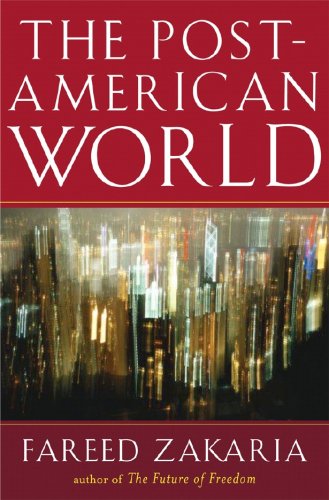 So, I've talked about how politicians and news people influence us with their tricky, tricky words. What's the best way to cut through all the crap and get to the reality of the situation? How do we see through the word play in order to understand what's really going on?
There is no easy method of doing this though, in lieu of the ability to read minds or tell when people are lying. The question of when to trust politicians and when to think they're being facetious is not under my jurisdiction. A good way to understand what's going on in the world, though, is to get information from more moderate sources, sources not pushing their political agendas, or perhaps even get pure facts.
Yes, absorbing all this information equates to a lot of reading. Here's a suggestion to start you out:
Although Fareed Zakaria is liberal leaning, his book, "The Post-American World," gives an accurate and balanced portrayal of the current world situation involving the industrialization of many third world nations, in what he terms to be "the rest rest," a term which mirrors "the rise of the West," and the "rise of the United States," which occurred previously. In the book, he outlines what he believes, reasonably and with evidence, to be the pros and cons of the "rise of the rest" (with primary focus on China and India), and how he believes the U.S. should react to the "rise of the rest."
As you (I hope) know, news has, over time, shifted from an informational focus to an entertainment focus. News stations are private companies whose goal is to generate revenue; sensationalism seems to generate more revenue than pure, dry facts and balanced coverage of world issues. Therefore, news stations tend to hype up situations and report disasters and give doomsday scenarios in order to attract viewers. One of the situations they've hyped up is the rise of China/India; many news stations treat the rise of China/India as a very negative thing, as the Chinese are buying up US debt and the US is losing power, respectively, to foreign powers. Quite frankly, yes, the buying of US debt is not good for the US, and the US is losing power, respectively. Fareed Zakaria addresses this in his book. However, he gives another point of view, a non-doomsday point of view; he explains to the reader how the US can actually benefit from the rise of China and India, why it is not currently benefiting as much as it could, and what needs to change in the US in order for the US to benefit. This point of view is valuable and informative, and definitely more useful than a 2 minute news blurb telling us we're all going to be slaves of China one day.
Subscribe to:
Posts (Atom)