Wednesday, January 26, 2011

State of the Union, 2011

Wordle: State of the Union 2011

Recently, President Obama gave the 2011 State of the Union address. I've taken the liberty of creating a Wordle based on his speech (link to full size image here). The Wordle analyzes the speech and finds the most used words, and creates an image based off these words where the more frequently used words are larger than less frequently used words.

Before I get into the linguistic details, I'll just briefly say what I generally thought about the content of the speech: his policies are aimed at the center. Obama offered to make concessions and compromises to both liberals and conservatives (such as offering to work on medical malpractice reform, and offering a spending freeze), but also maintained many of his own interests (increasing R&D, working on education reform, etc.). His speech was crafted with the intent to unify the American people and government (to a lesser degree), using the "us vs. them" dichotomy, where Americans are "us" and rising foreign powers who are gaining power or are vying for dominance (China, India, etc.) are "them."

Perhaps worth noting are some of these largest words in the Wordle; new, jobs, future, years, etc. His speech was very much focused on our weak economy; many of his main issues, such as energy and R&D, he tied back to job growth. The focus on "new" (new innovation, new jobs) and the focus on the future and years to come indicate that, although we do have short term problems that we need to resolve, Obama feels the need to address the long terms problems that we currently face and often neglect (environmental problems, the deficit, the debt, etc.). We need to look to the future, else there may not be much of a future left to look forward to.

There was also a running theme in his speech, wherein he referenced American exceptional-ism and our need to be better than/beat the rest of the world. This falls into the "us vs. them" dichotomy, and is probably meant to inspire Americans, as few things motivate us as well as Victory. Many times in his speech, he basically declared that America is the best country in the world. While I don't disagree, I wonder how other countries around the world view this?

Monday, January 3, 2011

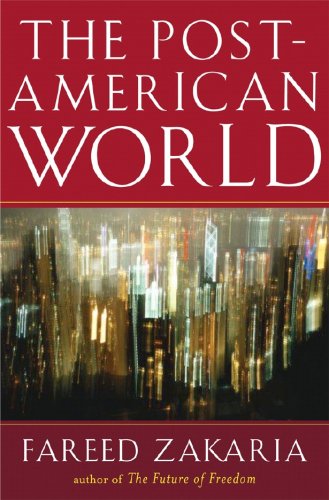
The Post-American World

So, I've talked about how politicians and news people influence us with their tricky, tricky words. What's the best way to cut through all the crap and get to the reality of the situation? How do we see through the word play in order to understand what's really going on?

There is no easy method of doing this though, in lieu of the ability to read minds or tell when people are lying. The question of when to trust politicians and when to think they're being facetious is not under my jurisdiction. A good way to understand what's going on in the world, though, is to get information from more moderate sources, sources not pushing their political agendas, or perhaps even get pure facts.

Yes, absorbing all this information equates to a lot of reading. Here's a suggestion to start you out:

Although Fareed Zakaria is liberal leaning, his book, "The Post-American World," gives an accurate and balanced portrayal of the current world situation involving the industrialization of many third world nations, in what he terms to be "the rest rest," a term which mirrors "the rise of the West," and the "rise of the United States," which occurred previously. In the book, he outlines what he believes, reasonably and with evidence, to be the pros and cons of the "rise of the rest" (with primary focus on China and India), and how he believes the U.S. should react to the "rise of the rest."

As you (I hope) know, news has, over time, shifted from an informational focus to an entertainment focus. News stations are private companies whose goal is to generate revenue; sensationalism seems to generate more revenue than pure, dry facts and balanced coverage of world issues. Therefore, news stations tend to hype up situations and report disasters and give doomsday scenarios in order to attract viewers. One of the situations they've hyped up is the rise of China/India; many news stations treat the rise of China/India as a very negative thing, as the Chinese are buying up US debt and the US is losing power, respectively, to foreign powers. Quite frankly, yes, the buying of US debt is not good for the US, and the US is losing power, respectively. Fareed Zakaria addresses this in his book. However, he gives another point of view, a non-doomsday point of view; he explains to the reader how the US can actually benefit from the rise of China and India, why it is not currently benefiting as much as it could, and what needs to change in the US in order for the US to benefit. This point of view is valuable and informative, and definitely more useful than a 2 minute news blurb telling us we're all going to be slaves of China one day.